Roofing Ballston Spa's Downtown and County Buildings
Review the scope, field conditions, system options, and planning considerations for this commercial roofing topic.
Read More →
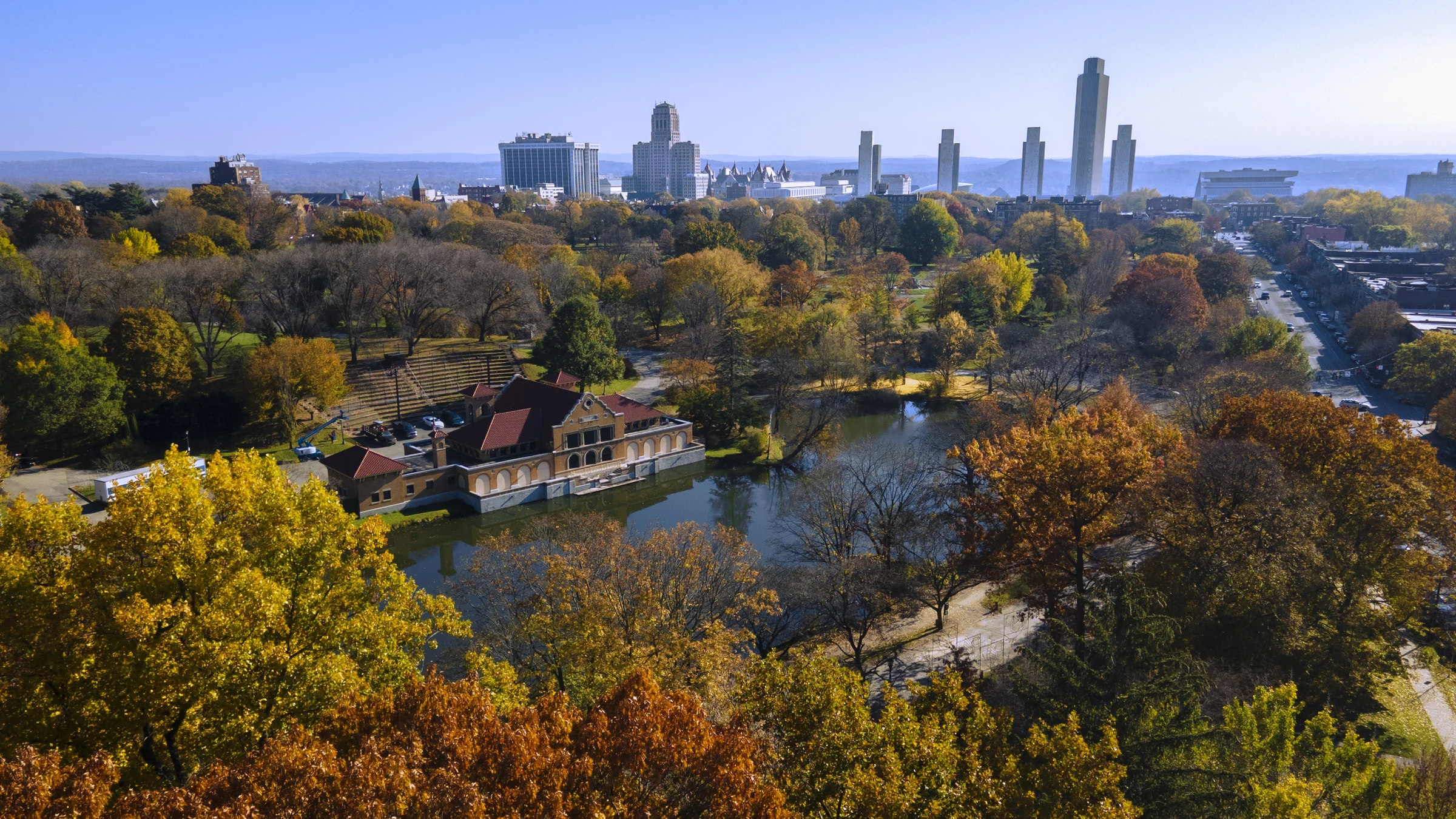
Commercial roofing in Rensselaer should begin with a documented assessment of membrane condition, seams, flashings, drainage, penetrations, and moisture before repair, coating, or replacement is selected. Rensselaer's commercial roof stock breaks into three separate problems that don't price the same way. There's the transit-hub cluster built up around the Albany-Rensselaer Amtrak station, there's the enormous single-tenant field at Regeneron's manufacturing campus, and there's the older brick-and-steel industrial stock strung along the Hudson River south of downtown. A bid that treats all three like one generic "commercial roof" quote is a bid that hasn't actually walked the buildings.
The Amtrak station sits on the east bank of the Hudson across from downtown Albany, and the parking structure, hotel, and office and retail buildings that grew up around it operate around a train schedule, not a construction schedule. A parking garage roof deck or an adjoining office roof can't just shut down access for a week because a crew wants a clear staging area. We schedule material staging and hoisting around peak arrival and departure windows, and we tell owners up front when a job needs to happen in phases instead of one continuous push, because guessing on that timeline is how a two-week reroof turns into a month of half-finished sections.
Noise and dust control matter more here too. A hotel with guests trying to sleep near a train platform doesn't need a tear-off adding to the racket during the wrong hours, and we build that into the schedule rather than treating it as a complaint to manage after the fact.
Regeneron's biologics manufacturing campus in Rensselaer put a set of roofs on the map that don't resemble anything else in the market. These are large, flat, single-membrane fields sitting over process space, not office space, and the rooftop mechanical load is heavier and denser than a typical commercial building: chillers, air handling units, exhaust stacks, and support equipment tied to controlled manufacturing environments below. A roof section that looks like standard TPO from the parking lot can be carrying loads and penetrations that a generic bid never accounted for.
Access protocols matter as much as the roofing work itself. Contamination control and site security procedures govern who gets on the roof and how, and a crew that hasn't planned for gowning, badge, or escort requirements will burn schedule time relearning the site's rules on day one instead of showing up ready. We ask about site access procedures before we quote, not after we've won the job.
South along the Hudson, the older industrial stock tells a different story. Brick and steel-frame buildings from an earlier industrial era, some still served by rail spur access, carry built-up or modified bitumen roofs that have been recovered or patched more than once. Drainage is the recurring issue in this stretch. Low-lying sections near the river don't always drain the way the original design intended, decades of settling and additions have changed the roof's slope in places, and a patch job that ignores the underlying drainage problem just relocates the leak to the next low point.
We also see rail dust and general industrial grime built up on membranes that haven't been cleaned or inspected in years, which matters when a recover system depends on adhesion to the existing surface. Skipping that prep step to save a day is how a recover system fails early.
The most common mistake is a flat per-square-foot number quoted without walking the actual roof. A Regeneron-scale field, a station-cluster parking deck, and a riverfront industrial building all carry different labor, access, and equipment requirements, and pricing them off the same rate sheet is how an owner ends up with change orders stacking up mid-project. We also see bids that ignore the access and scheduling coordination this city requires, whether that's train-adjacent noise limits or manufacturing-site security clearance, and quietly plan to bill that time later as an extra.
The other pattern is a contractor who quotes a recover system without checking what's underneath it. On the riverfront blocks especially, a roof with a documented history of small patches usually has a drainage or deck issue driving those patches, and a recover layered over an unresolved problem just buys a few dry years before the same leak resurfaces.
We work on private commercial and industrial buildings in Rensselaer, which includes campus support structures where site access and security procedures allow it. We confirm the access protocol before quoting rather than assuming a standard commercial walk-through applies.
We schedule staging, hoisting, and noisy work around train arrival and departure windows and around hotel occupancy patterns, and we phase larger jobs when a continuous shutdown of access isn't realistic.
Recurring leaks in an older industrial building are usually a drainage or deck symptom, not a membrane defect in isolation. We look at slope and drainage history before recommending another patch or a full recover.
Yes, particularly on older buildings where additions and settling have changed the original roof slope over time. We check actual drainage performance during a rain event when possible, rather than relying only on the as-built plans.
We coordinate staging and material delivery timing with any active rail or dock schedule on the property so our equipment doesn't block an operation the tenant still depends on.