Standing Seam Metal for Snow Load and Curb Appeal
Review the scope, field conditions, system options, and planning considerations for this commercial roofing topic.
Read More →
When three roofing quotes come back for the same Albany building and one is 30 percent lower than the others, that gap is telling you something about scope, not the price alone. We write reroofing bids to be compared line by line, because that's the only way an owner or facilities director can tell whether a low number means efficient work or missing scope.
The easiest place to trim a number is insulation. A bid that lists "insulation as needed" instead of a specific thickness and R-value isn't giving you a real number, it's giving you a that gets filled in after the contract is signed. On a flat institutional roof carrying Capital Region snow loads, insulation thickness also affects tapered drainage design, so a vague spec there usually means vague drainage too.
Deck repair is the second common gap. Older buildings around downtown Albany and Troy often have steel or plank decks with decades of patched penetrations, and nobody knows exactly how much rusted or rotted deck will turn up until tear-off starts. A bid with no unit price for deck replacement, or one that buries it in a vague allowance, leaves the owner exposed to a change order with no ceiling on it.
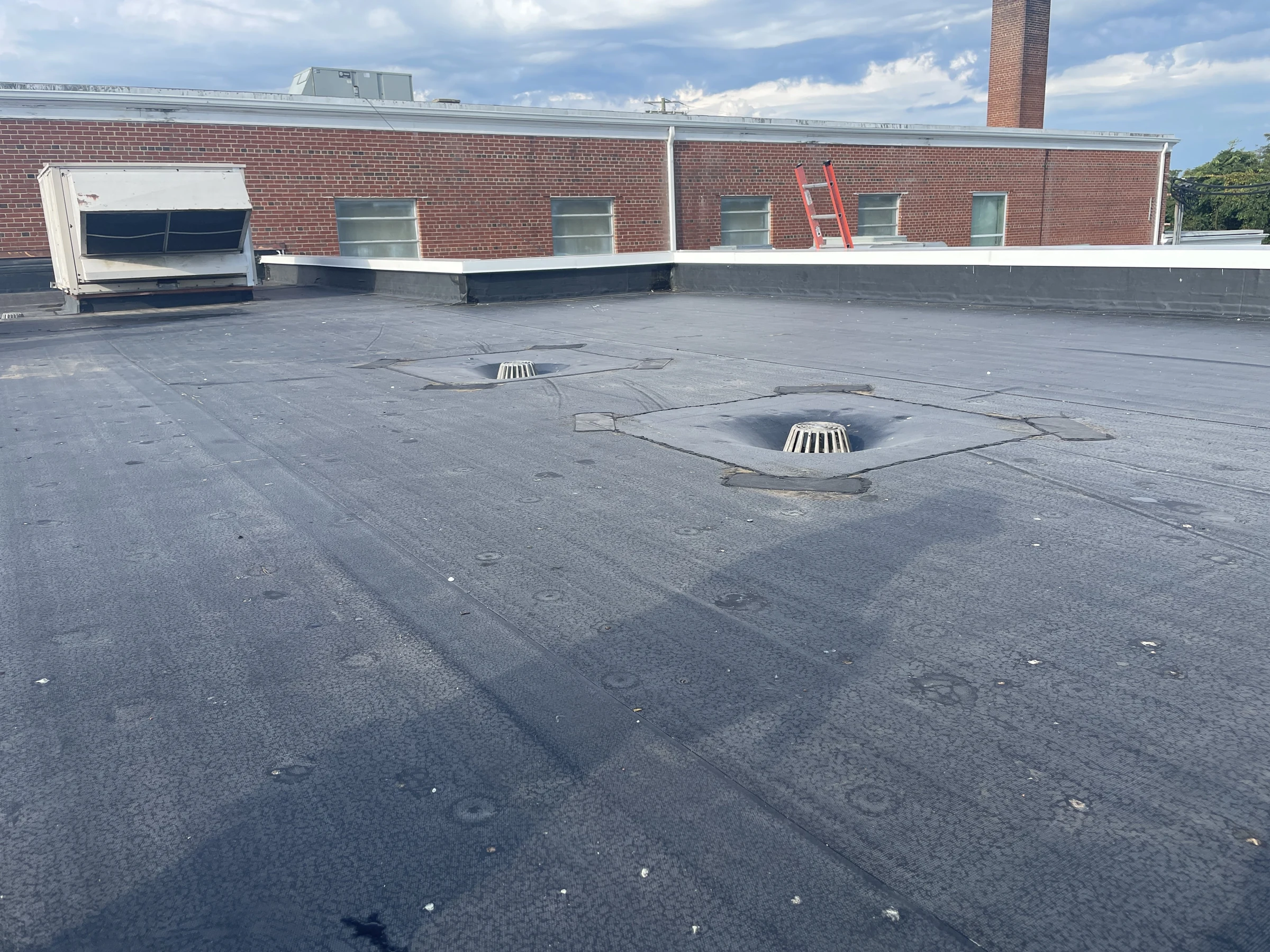
A reroof around the Capitol complex or the Empire State Plaza has to account for state building code snow load requirements on large flat roofs, and that's a structural and drainage question before it's a membrane question. We check existing drainage capacity, tapered insulation slope, and any low spots that have been collecting standing water before we ever talk about TPO versus EPDM.
SUNY Poly's Albany Nanotech campus and similar institutional facilities run rooftop mechanical loads that older assemblies were never designed around. A reroof scope on that kind of building needs to account for curb heights, equipment pads, and walkway pad placement rather than a blanket membrane swap.
Mohawk and Hudson valley wind events aren't hurricane-force, but they're frequent enough that fastening density matters more here than a bid summary usually lets on. Mechanically attached, fully adhered, and induction-welded systems all carry different wind uplift ratings, and a bid that doesn't specify which attachment method it's pricing is asking you to trust a number without knowing what it's actually buying.
Mill buildings and converted industrial space in Cohoes and Troy frequently have plank decks under multiple recover layers, sometimes three or four roofs deep. Tear-off on that kind of building can reveal wet, degraded plank that has to be sistered or replaced before a new membrane goes down, and that work is priced very differently across contractors.
Newer distribution and warehouse construction around Schodack and Selkirk typically has cleaner steel deck, which simplifies the tear-off scope but doesn't eliminate it. We still core-sample before quoting a firm number, because assuming a clean deck on an unseen roof is how change orders happen.
State office buildings, hospitals, and schools in the Capital Region don't get to shut down for a reroof, so sequencing matters as much as the roof assembly itself. We phase tear-off in sections small enough to dry in before end of day, coordinate with building security and facilities staff on roof access, and plan around tenant hours rather than assuming an empty building.
Winter is the other scheduling constraint that gets glossed over in a lot of bids. A reroof that starts in October and runs into heavy wet snow season needs a real weather-stop plan instead of a hopeful completion date. We build in the point where crews stop opening new roof sections and shift to dry-in and cleanup, because an open roof during a nor'easter is a bigger risk than a slightly extended schedule.
Older single-ply and built-up roofs across the metro sometimes qualify for a recover instead of a full tear-off, which can save real money if the existing deck and insulation are dry and sound. But a recover over wet insulation just traps the moisture problem under a new membrane, so we moisture-scan before recommending it rather than defaulting to whichever option is faster to quote.
We'll tell a property owner directly when a recover is the wrong call, even though it's the cheaper number on paper. A membrane that fails in three years because it was laid over saturated insulation costs more than doing the tear-off correctly the first time.
Usually it's scope, not efficiency. Vague insulation specs, no deck repair unit pricing, and unspecified attachment methods let a contractor quote a lower headline number while leaving the actual cost to show up later as change orders. We walk owners through exactly what our number includes so it can be compared fairly.
It depends on square footage, deck condition, and how much of the building has to stay occupied during work, but most mid-size flat roofs in the Capital Region run a few weeks once tear-off starts. We give a realistic range up front rather than an optimistic best case.
It can, within limits. We plan sections that can be fully dried in before weather turns and build stop points into the schedule for heavy snow or ice events. A reroof that starts in late fall needs that kind of plan written into the contract, not left as an assumption.
That's exactly why we push for a unit price on deck repair in the original bid instead of a vague allowance. When we find rusted steel deck or rotted plank, we document it with photos, price it at the agreed unit rate, and get sign-off before proceeding rather than surprising the owner with an open-ended number.
Sometimes, if the scope is genuinely equivalent. Our advice is to make every bidder specify the same line items before comparing price, because a low number built on a thinner insulation spec or a weaker attachment method isn't actually the same roof.