Reading Storm Damage Correctly Before Anyone Writes a Repair Scope
Review the scope, field conditions, system options, and planning considerations for this commercial roofing topic.
Read More →
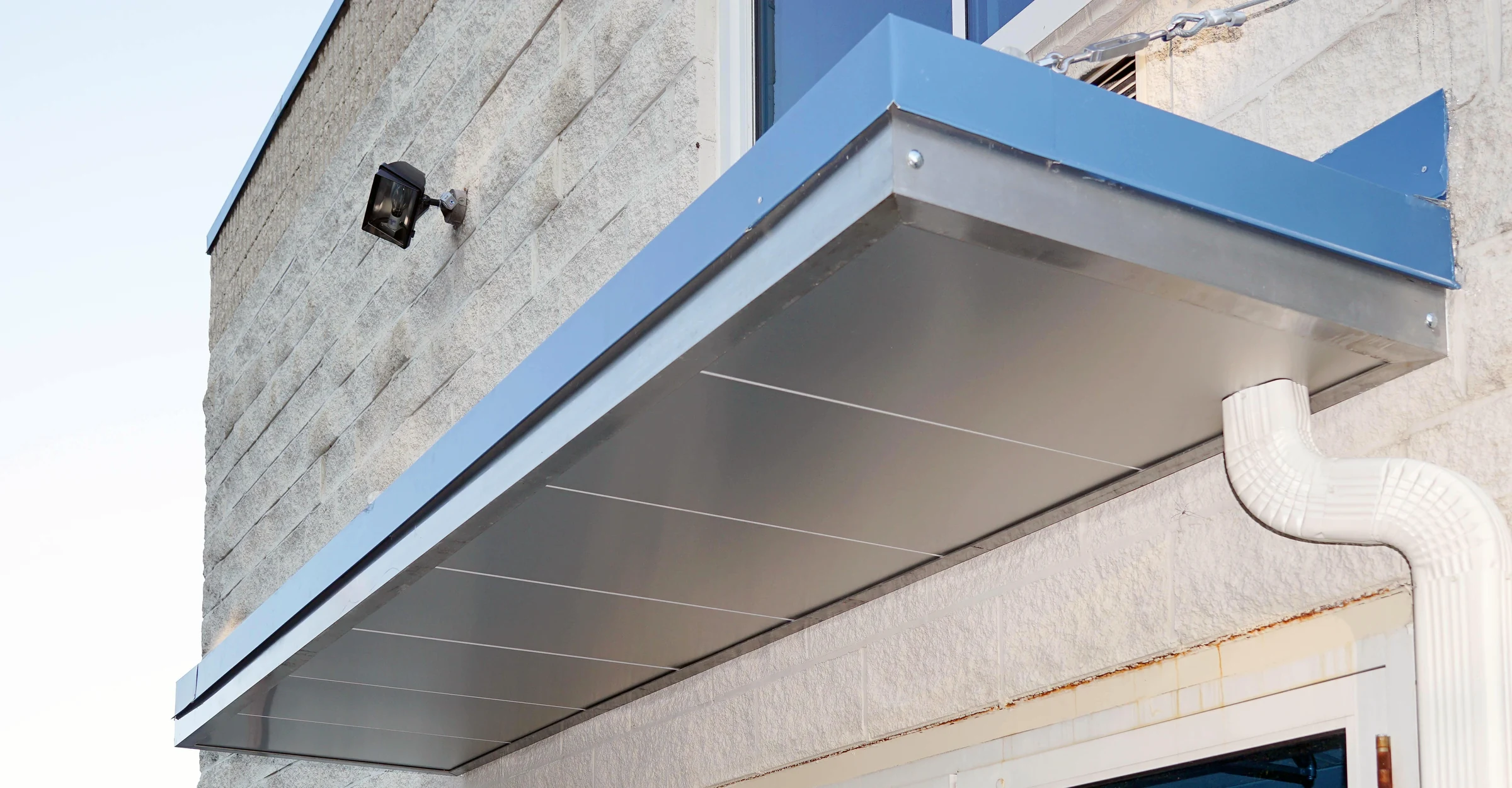
Edge metal, coping, and gutters get mentioned in a lot of reroofing bids in a single throwaway line, as if they're trim to be matched at the end rather than part of the roof system that decides whether wind and water actually stay out. On buildings carrying real snow load and frequent freeze-thaw cycling, this detail does as much work as the membrane itself.
Parapet coping caps the top of a wall and sheds water away from the wall assembly below, and every joint in that coping is a potential entry point if it isn't fastened and sealed correctly. Freeze-thaw cycling through a Capital Region winter works loose fasteners at these joints gradually, season after season, until a joint that was tight in the fall is loose enough by spring to let wind-driven rain in during the next nor'easter.
We check coping fastener spacing and joint sealant condition as a standard part of any inspection or maintenance visit, not only when there's already a visible leak. A loose coping joint rarely announces itself before it fails; it just quietly lets water in until someone notices a stain on the wall below.
Wind uplift forces concentrate at roof edges more than anywhere else on the field, which is why edge metal attachment specifications exist as their own engineered detail in wind design standards, not an afterthought to membrane selection. A bid that specifies membrane and attachment method but glosses over edge metal gauge, fastener spacing, and cleat design is leaving out the detail most likely to fail first in a Mohawk or Hudson valley wind event.
We specify edge metal to match the wind exposure and building height of the specific roof, rather than defaulting to a standard detail regardless of conditions. A low building in a sheltered industrial park doesn't need the same edge metal spec as a taller building exposed on an open site near the airport or along an open retail corridor.
A gutter system sized for ordinary rainfall can be overwhelmed by rapid snowmelt off a large flat roof, especially during a quick warm-up after a heavy snow event, when a substantial volume of water tries to move through the system at once. Undersized or clogged gutters back up under those conditions, and that backup pushes water toward the roof edge and fascia in ways that a rainfall-only design never anticipated.
Downtown storefronts in Ballston Spa and mill-era buildings in Cohoes often have decades of layered repairs to edge metal and gutters, sometimes with mismatched profiles from different eras patched together. That patchwork can look fine from the ground while performing inconsistently, with some sections properly fastened and sloped and others just tacked in place during a past emergency repair.
We evaluate the full run of edge metal and gutter on older buildings rather than assuming uniform condition, because a single weak section is often where the next failure happens, regardless of how solid the rest of the run looks.
A bid that says "new edge metal to match existing" without a gauge, finish, and fastening spec is asking for trust rather than giving you something to compare against another bidder. We spell out metal gauge, finish type, fastener spacing, and cleat or continuous-lock attachment method, because those specifics are what determine whether the new sheet metal actually performs better than what it's replacing.
Warranty language around sheet metal also deserves attention most bids skip. Membrane manufacturer warranties sometimes exclude sheet metal components entirely, or require a specific detail to remain in warranty, and we make sure a property owner knows which parts of the roof system a stated warranty actually covers before signing.
We check them as part of our standard pre-winter and post-winter maintenance visits, since freeze-thaw cycling is the main driver of fastener loosening in this climate. A building without a maintenance program should still have this checked at least once a year, ideally before winter.
Often yes, if the underlying membrane and wall assembly are sound. Refastening or resealing a coping joint, or replacing a section of edge metal, doesn't necessarily require disturbing the field membrane, though we always check for related membrane damage at the same time.
Rapid snowmelt off a large flat roof can move more water through a gutter system in a shorter window than an equivalent rainfall would, especially if the gutter or downspouts have any debris or ice restriction. We size and evaluate gutter capacity against that scenario, not standard rainfall design alone.
Edge metal typically refers to the metal flashing at a roof's perimeter where there's no parapet wall, directing water off the roof edge. Coping caps the top of an actual parapet wall. Both handle wind uplift and water shedding, but they're different details with different failure points.
We can match existing profiles and finishes where that matters for the building's appearance, particularly on visible street-facing sections. Where appearance isn't a factor, we prioritize the gauge and attachment spec that performs best for the building's wind exposure.