PVC's Real Advantage Is Chemical Resistance, Not a Default
Review the scope, field conditions, system options, and planning considerations for this commercial roofing topic.
Read More →
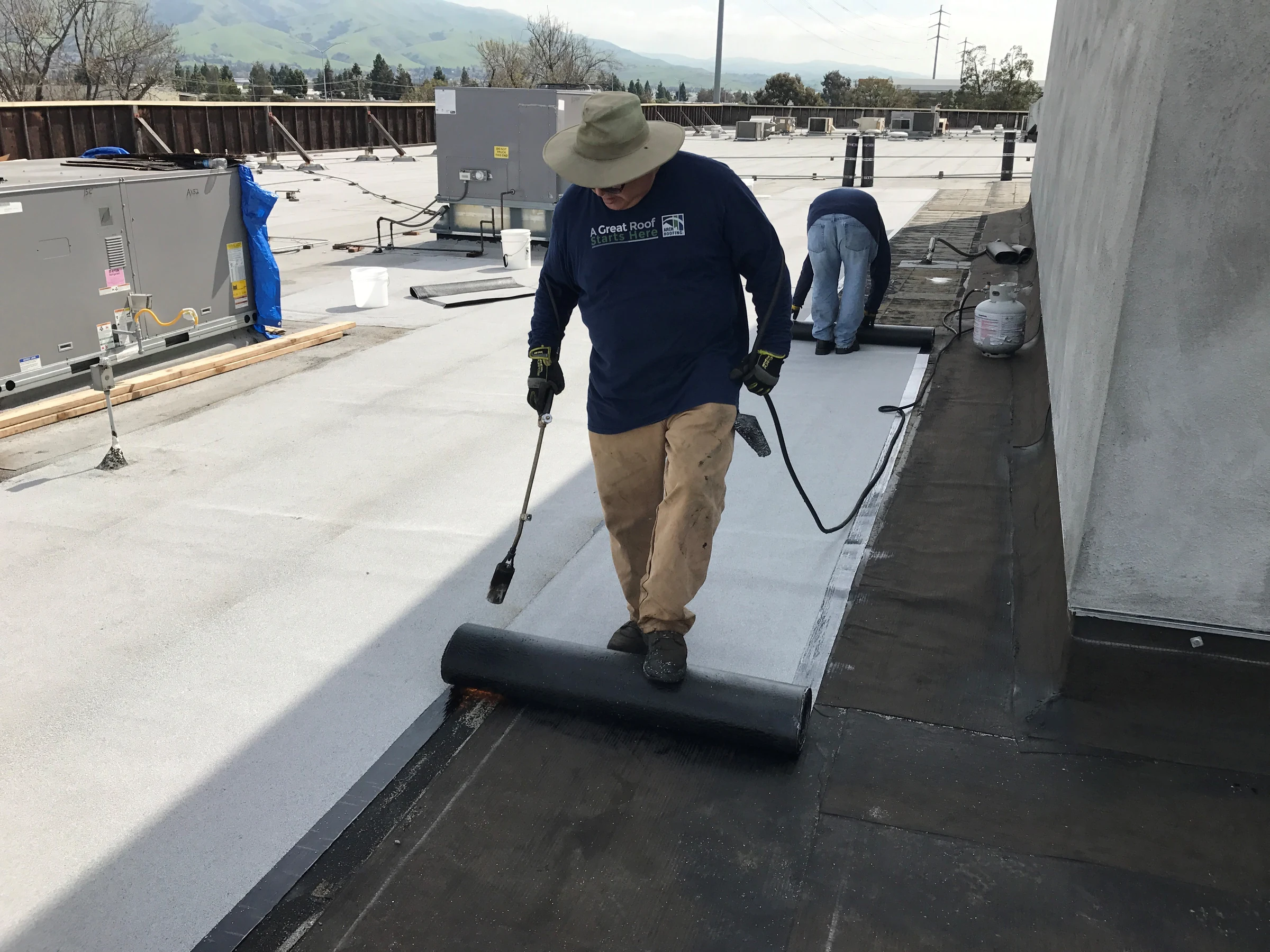
SBS modified bitumen gets applied by torch, hot asphalt, cold adhesive, or self-adhered sheet, and the application method changes both the fire risk during installation and the finished roof's performance. A bid that just says modified bitumen without stating which method leaves out the detail that matters most on an occupied building.
Torch-applied SBS uses an open flame to melt the underside of the sheet and bond it to the substrate below, which is fast and produces a strong bond but introduces real fire risk during installation, especially on a roof over an occupied building with insulation, wood blocking, or other combustible material near the work area. Hot-mopped asphalt applies similarly hot material without an open flame at the membrane itself but still involves heated kettles on site.
Cold-applied adhesive and self-adhered peel-and-stick SBS sheets avoid open flame and heated material entirely, trading some installation speed for a meaningfully lower fire risk profile, a real consideration on schools, hospitals, and any occupied building where a roof fire during construction isn't a hypothetical.
Torch-applied SBS produces a strong, consistent bond and remains a standard method for good reason on appropriate roofs, particularly where deck conditions and existing insulation make a torch application straightforward and low-risk. The issue isn't torch application itself, it's a bid that doesn't disclose the method or the fire watch precautions being taken during installation.
A responsible torch application includes a fire watch during the workday and for a defined period after work stops, since smoldering material in insulation or blocking can ignite hours after the crew has left the roof. A bid that doesn't mention fire watch procedures on a torch-down job is skipping a real safety step, not only a paperwork formality.
Older municipal buildings with wood deck or wood blocking under a prior built-up roof carry more torch risk than a poured concrete or steel deck building, and that's a deck-specific detail we confirm before deciding whether torch application is appropriate at all, or whether a cold-applied or self-adhered method is the safer route regardless of installation speed.
SBS systems commonly install as a two-ply system, a base sheet and a granulated cap sheet, which gives the roof redundancy that single-ply membranes like TPO or EPDM don't have by design. If the cap sheet develops a localized problem, the base ply underneath is still providing waterproofing, which is part of why modified bitumen remains a common choice on institutional buildings where a single point of failure taking out the whole roof's protection is a bigger risk to manage.
Granule coverage on the cap sheet also protects the asphalt from UV degradation, and granule loss over time, visible as bald patches or excessive granules in gutters and drains, is one of the clearer visual signs an SBS roof is approaching the end of its service life.
A bid that names modified bitumen without stating the application method is leaving out the detail most likely to affect both fire risk during installation and the finished roof's performance.
On a modified bitumen bid we check for:
A lot of older institutional buildings around the region, municipal buildings, older school wings, already carry a built-up or modified bitumen roof from a prior generation, and recovering with a new SBS cap sheet over a sound existing system is often more economical than full tear-off, provided the existing plies are dry and adhered.
Where the existing roof has widespread blistering or delamination between plies, that's usually a sign moisture is already trapped in the system, and recovering over it just seals that moisture in under new material rather than solving the underlying problem.
It carries real fire risk if done without proper fire watch procedures, which is why we disclose the application method and safety protocol upfront rather than leaving it as an assumed detail.
Torch application uses open flame to bond the sheet; self-adhered sheets use factory-applied adhesive activated by pressure, avoiding open flame and heated material on the roof entirely.
The base sheet and cap sheet provide redundant waterproofing, so a localized problem in the top layer doesn't immediately expose the roof deck the way a breach in a single-ply membrane can.
Granule loss showing as bald patches on the membrane, or excess granules collecting in drains and gutters, are visible signs the cap sheet's UV protection is diminishing.
Often yes, if the existing plies are dry and properly adhered. Widespread blistering or delamination usually means trapped moisture that needs to be addressed before recovering.